
Research
QEMISD advances room-temperature MWIR single-photon detection by combining ENZ nonlinear media, ultra-high-SNR detectors, and system-level QND integration across three Integrated Research Thrusts (IRTs).
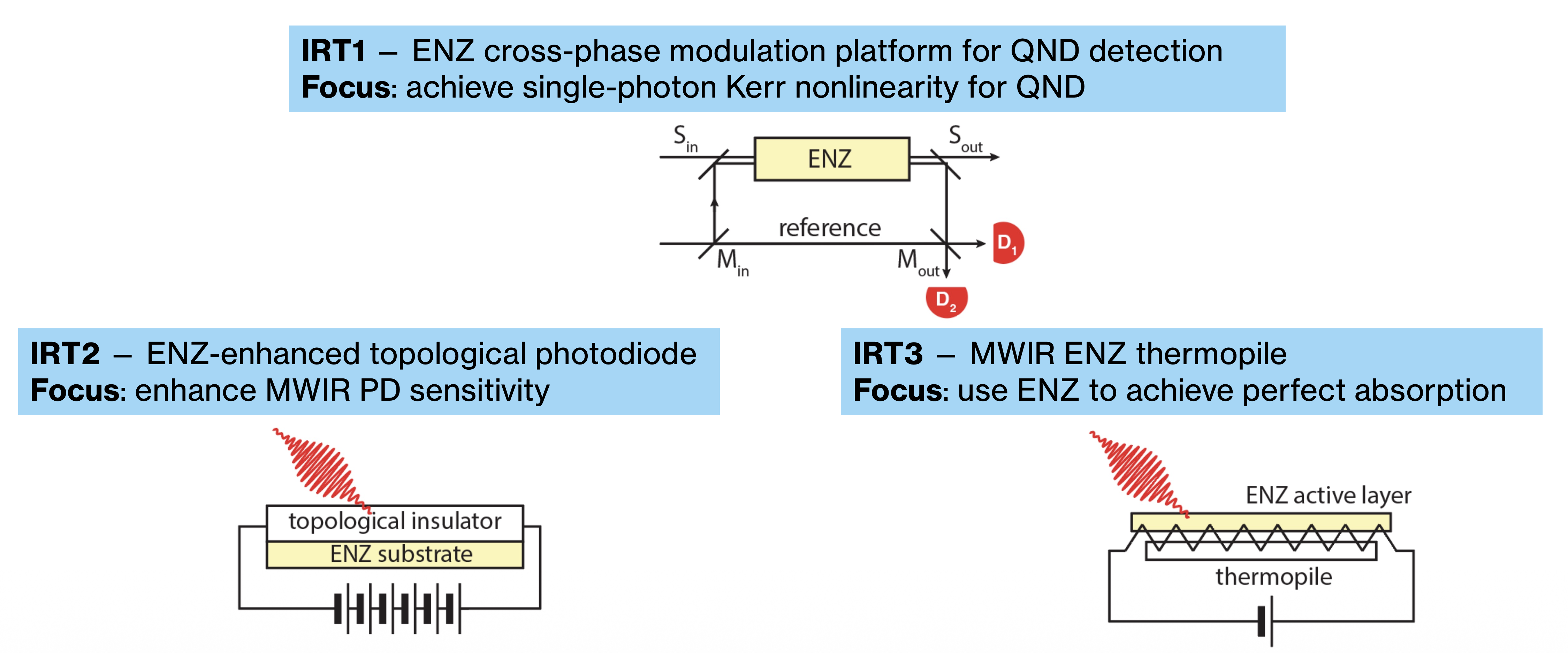
IRT 1 — ENZ XPM platform for QND detection
IRT 1 develops low-loss, strongly nonlinear ENZ (meta)materials that maximize MWIR cross-phase modulation (XPM) for quantum nondemolition (QND) measurements, while managing loss and damage thresholds. The thrust also advances theoretical and computational tools for realistic XPM at the single-photon level and integrates ENZ hosts into QND test platforms.
- ENZ material platforms (e.g., CdO / ITO) engineered for large Kerr nonlinearity with reduced optical loss.
- Modeling frameworks that include dispersion, loss, and non-Hermitian effects for realistic quantum optical prediction.
QND platform concepts based on probe phase readout via balanced detection.
IRT 2 — ENZ-enhanced MWIR Topological Photodiode
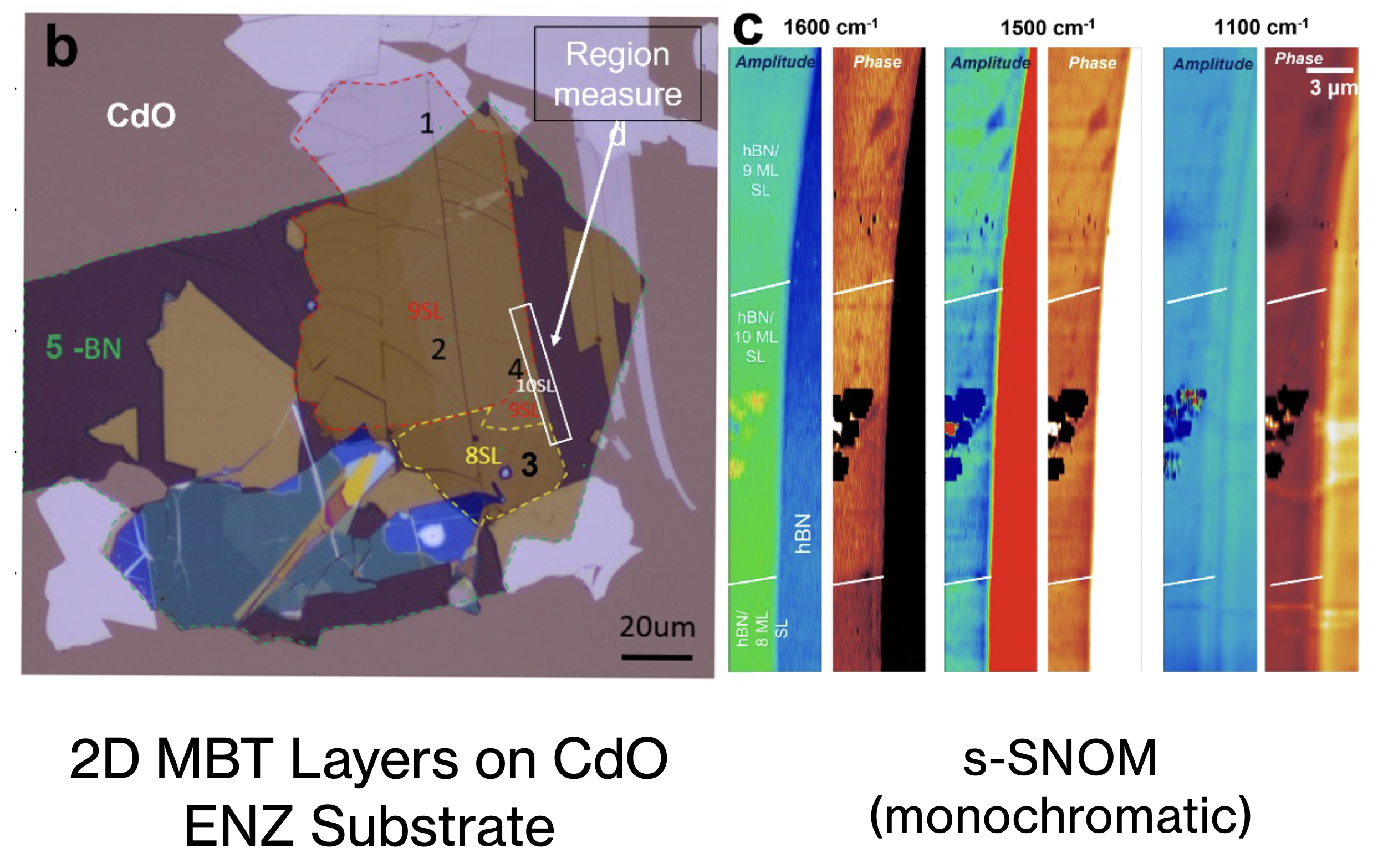
IRT 2 engineers ENZ–topological heterostructures to achieve MWIR photovoltaic detection with detectivity approaching the blackbody background limit at room temperature. Work includes perfect-absorption designs, intrinsic photovoltaic mechanisms in quantum materials, and device fabrication/characterization workflows to translate materials discoveries into detector performance.
- Perfect absorption structures coupled to ENZ and topological materials for enhanced MWIR responsivity.
- Device fabrication in inert environments and scanning photocurrent microscopy workflows.
Near-field / FTIR characterization and simulation-driven design loops for heterostructures.
IRT 3 — Nanophotonic MWIR ENZ Thermopile Detectors
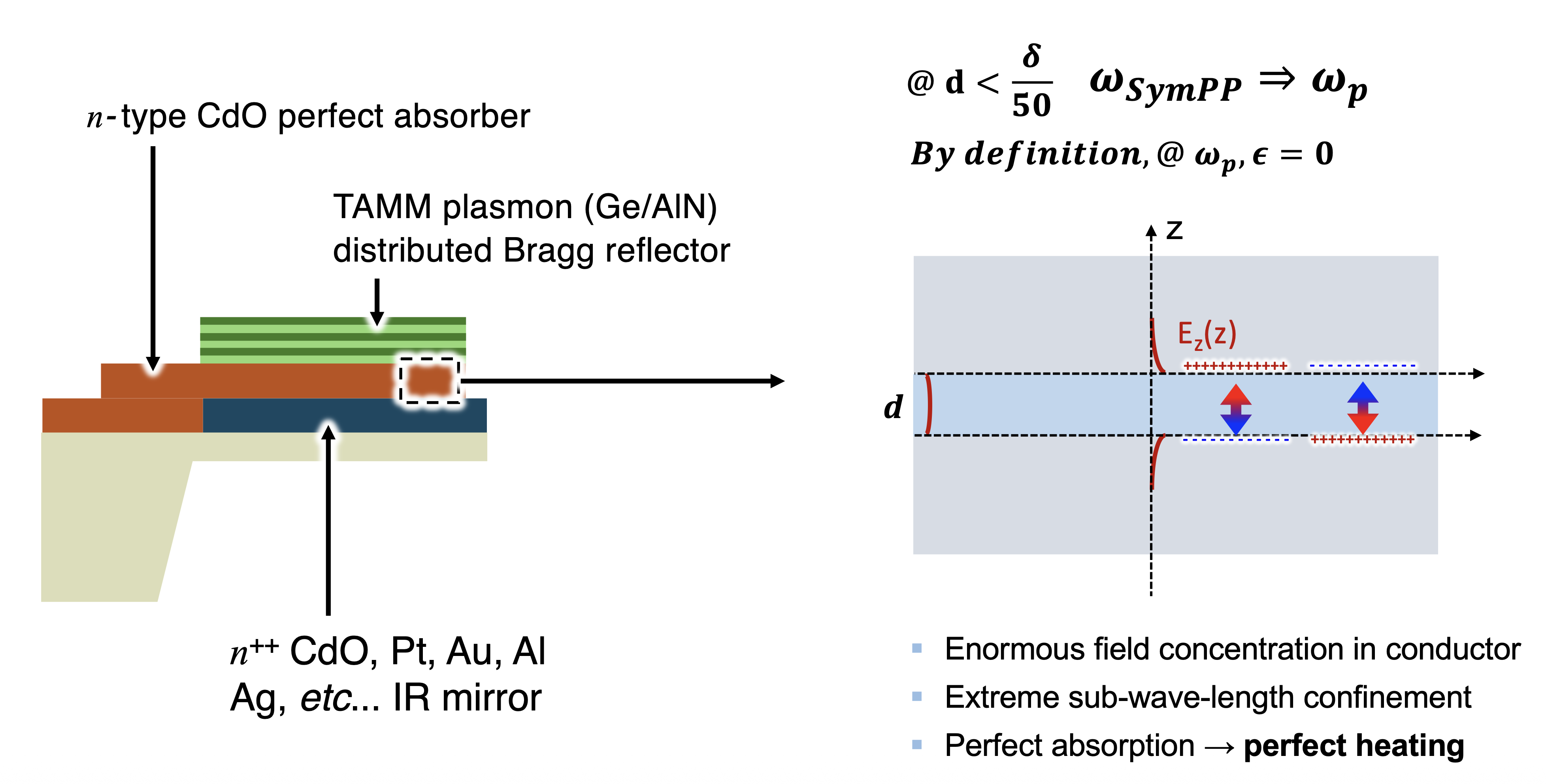
IRT 3 develops plasmonic ENZ bolometers/thermopiles designed for high thermovoltage, narrow spectral selectivity, and low noise MWIR detection. This includes improving ENZ host materials (e.g., CdO) for reduced loss, engineering interfaces that maximize thermovoltage, and developing scalable patterning/doping strategies for thermopile arrays.
- Growth and processing improvements to reduce optical loss and improve mobility in ENZ hosts (e.g., CdO).
- Nanophotonic absorber design for narrowband MWIR selectivity and enhanced thermal transduction.
Patterned doping/patterning approaches to enable thermopile geometries and scaling.
Cross-cutting capabilities
- Shared ENZ materials growth, characterization (optical, near-field), and nanofabrication workflows across IRTs.
- Joint system-level architecture connecting materials advances to detector performance and QND demonstrations.