Home Page
Quantum ENZ Materials for Midwave IR Single-Photon Detection
The QEMISD MURI program aims to enable room-temperature quantum nondemolition (QND) detection of single midwave infrared (MWIR) photons—distinguishing them from thermal background photons—by exploiting extreme nonlinear optical responses in epsilon-near-zero (ENZ) materials.
Goal: “fish” a MWIR single photon out of a sea of thermal photons.
How QEMISD Works
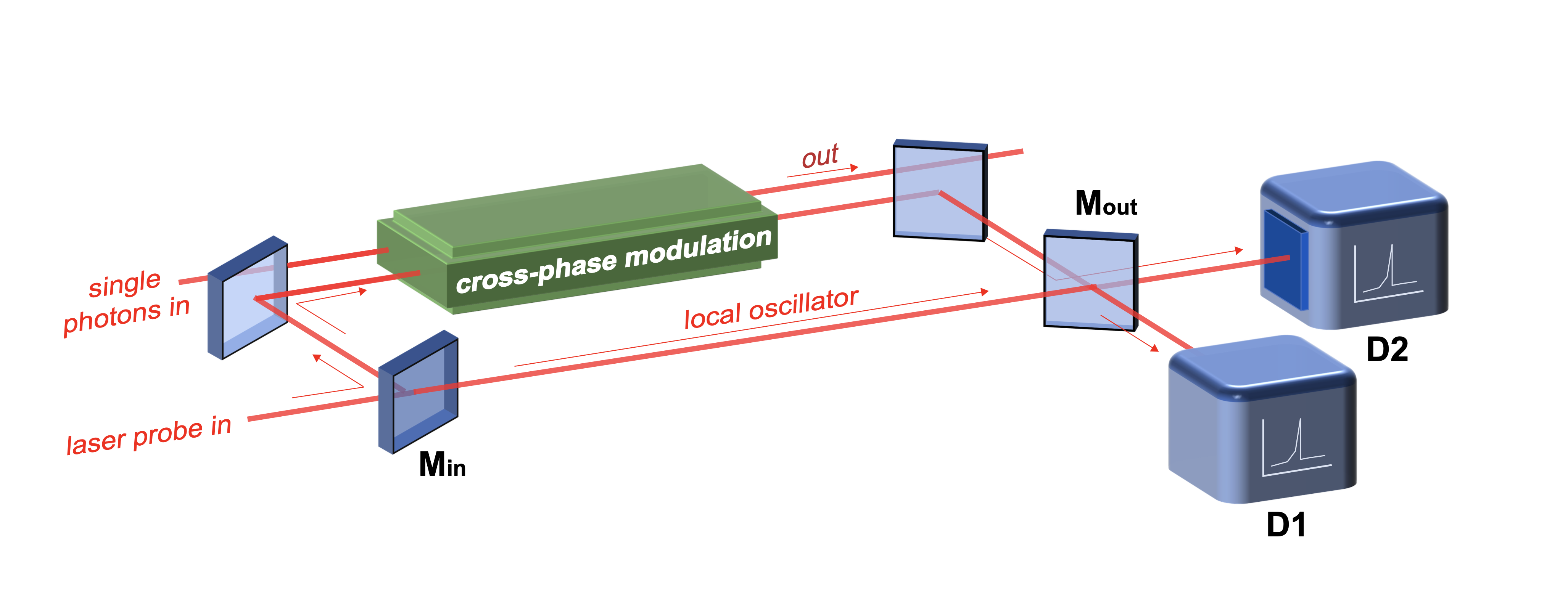
Quantum nondemolition (QND) detection measures a property of light—here, the photon number—while avoiding measurement back-action on the observable of interest. In QEMISD, a MWIR signal field and a strong probe co-propagate through a Kerr nonlinear medium where cross-phase modulation (XPM) imprints a phase shift on the probe that is proportional to the signal photon number. The probe phase is then measured interferometrically using balanced detection.
ENZ and zero-index metamaterials offer a path to overcome the two central challenges: (1) maximize XPM while minimizing loss and (2) maximize sensitivity while minimizing noise—making them promising for ultra-low-power QND measurements and detector integration.
Integrated Research Thrusts (IRTs)
QEMISD is organized into three parallel Integrated Research Thrusts, spanning theory, design, fabrication, characterization, and device integration.
Multi-Institution Team
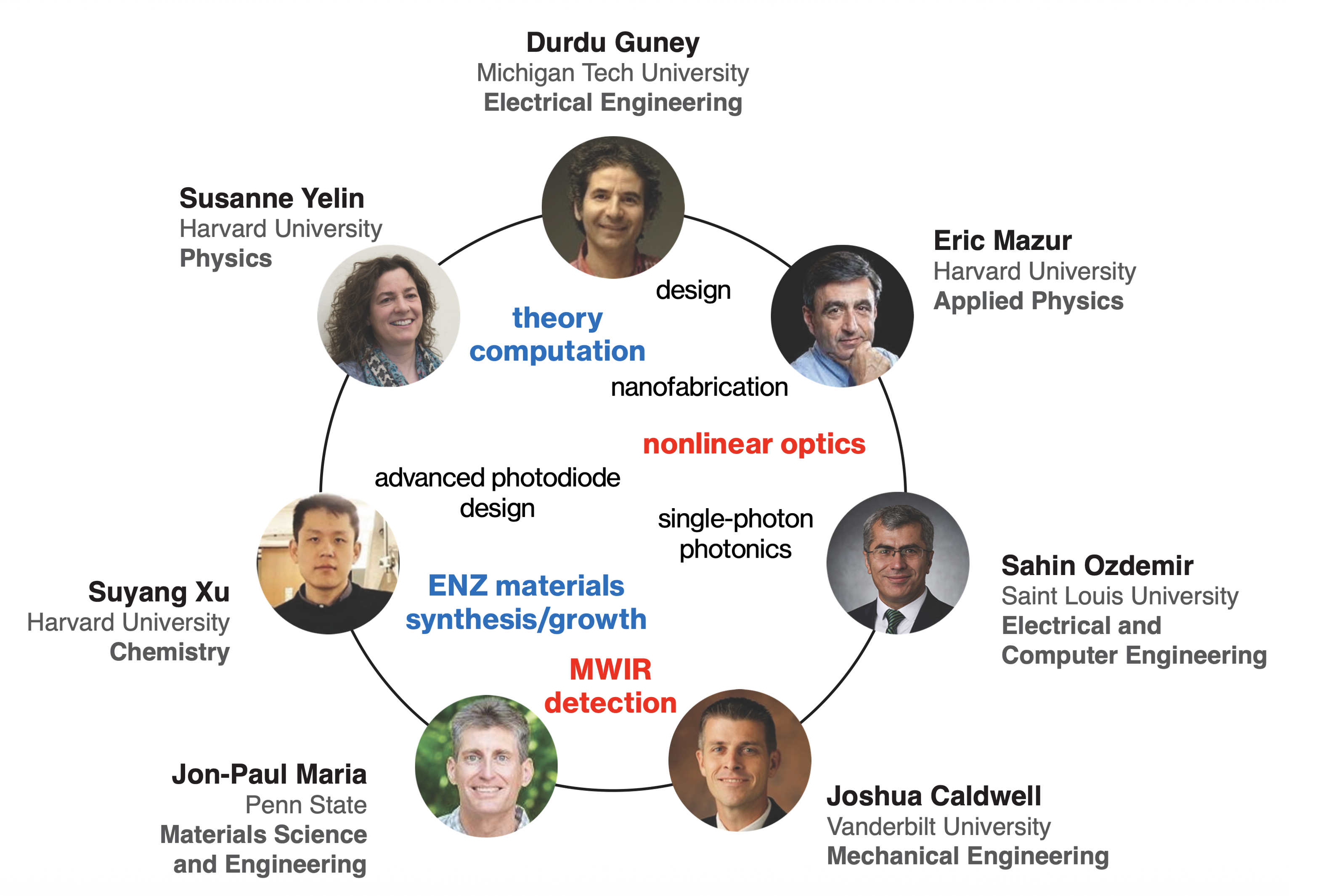
QEMISD brings together expertise in nonlinear optics, quantum measurement, ENZ materials, nanofabrication, and MWIR detection across multiple institutions.